Crafted Interiors

  • In 1863, after the Huế court signed the Treaty of Nhâm Tuất (1862), ceding to France three eastern provinces of Southern Vietnam (Gia Định, Định Tường, Biên Hòa) and Côn Lôn Island, Emperor Tự Đức still hoped to redeem them. The court therefore sent Phan Thanh Giản as chief envoy, accompanied by Phạm Phú Thứ, Ngụy Khắc Đản, and others, to France and Spain.

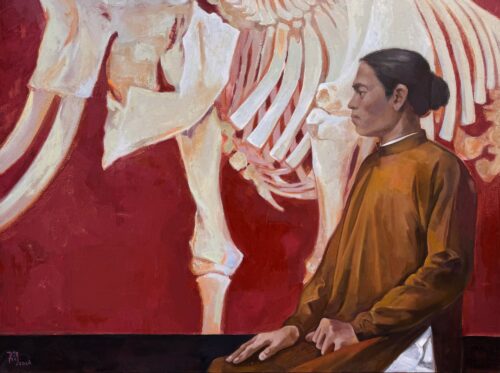
    It is a sorrowful story; one no one likes to revisit. Reading Vietnamese history from that period feels overwhelmingly bleak. And yet, I found myself drawn to the portrait of a young man within the delegation.

    A young man named Diệu. Twenty years old. Almost entirely unknown, leaving nothing in the historical record but his name and a single photograph. He was merely an attendant who accompanied the diplomatic mission to France.

    I was captivated by his eyes. There is something clear and eager in them, the glimmer of youth sparking against the heavy gloom of the time. In his small, quiet presence, I see the reflection of the entire nation: ordinary people with dreams and passions of their own, swept into the tide of immense upheaval.

    In events that seem to belong only to emperors and officials, what roles and memories remain for the nameless? They are both witnesses and those who bear the long echo of consequence.

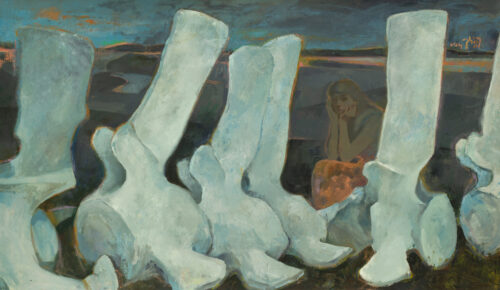
    The elephant skeleton carries its own meaning as well. The elephant, once a symbol of strength, authority, and the martial spirit of the imperial army, linked to many victories throughout the Lý, Trần, and Nguyễn dynasties, appears here only as the remains of a power that has faded. It evokes the late nineteenth century, when the country faced the loss of Southern Vietnam and the court stood powerless before foreign pressure.
    • Size - 30 x 40 " (76 x 101 cm)
    • Material - Oil on canvas
    • Year of creation - 2025
    • Published price -
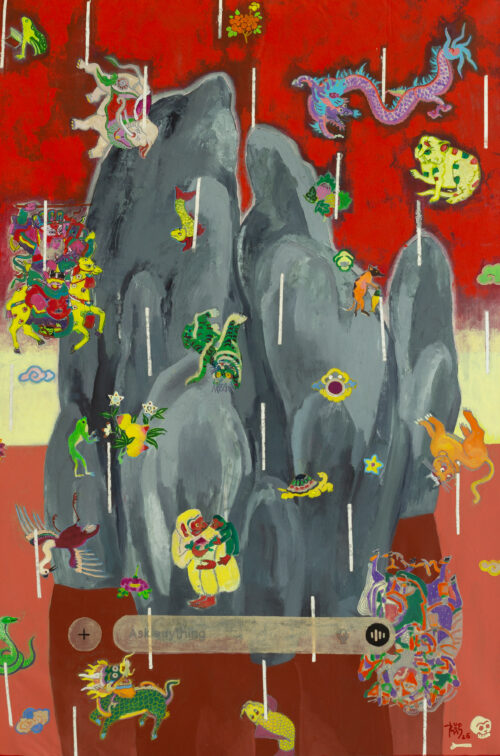
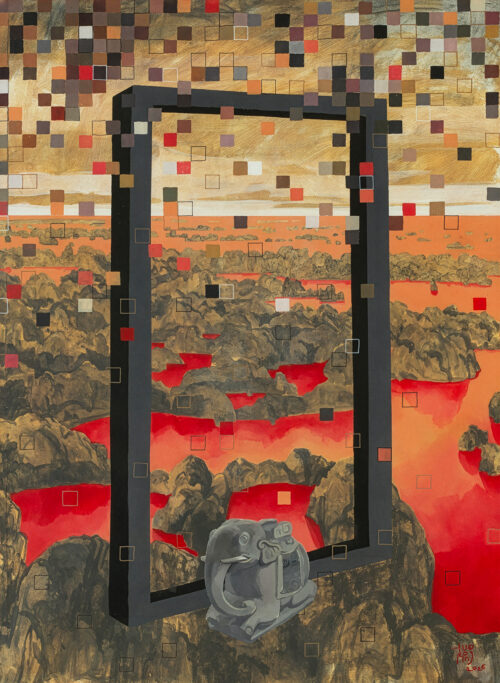
  • People in the East believe that geography possesses spiritual force, and that human beings can intervene in it.
    Yet the logic of trấn yểm (apotropaic rite) in Vietnam carries a crucial difference: rather than confidently mastering these forces, as in the cultures to the north, we understand that mountains, rivers, and spirits are never fully subdued. Any intervention is only a temporary measure, or a way of keeping danger from spilling over.
    Vietnam took shape under constant threat: natural disasters, floods, pressure from the north, and internal conflict. As a result, trấn yểmemerged not as an assertion of control, but as a reflex of a culture that does not believe stability to be a given.
    We know that dissolution is ever-present.

    • Size - 55 x 40 " (146 x 104 cm)
    • Material - Oil and acrylic on canvas
    • Year of creation - 2025
    • Published price -

    • Size - 30 x 24 " (76 x 61 cm)
    • Material - ink on zo’ paper, acrylic on canvas
    • Year of creation - 2025
    • Published price -
  •  

    • Size - 65 x 40 " (165 x 101 cm)
    • Material - Oil and acrylic on canvas
    • Year of creation - 2025
    • Published price -

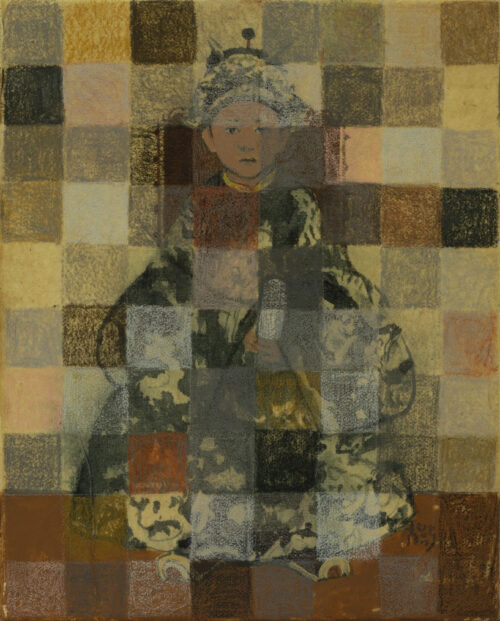
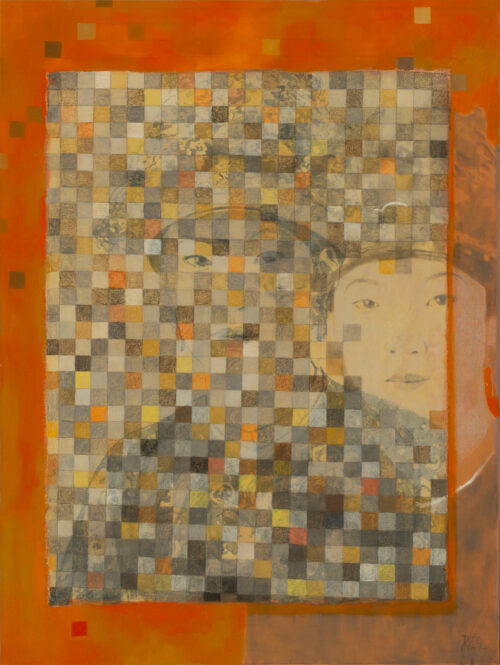
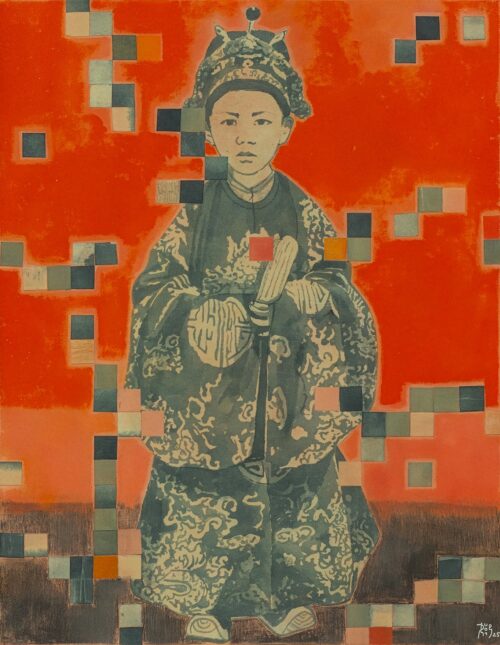
  • I use many pixel symbols in my paintings to convey a sense of decay and hyperreality.
    Decay: the dissolution of grand narratives (Lyotard), the decline of seemingly eternal symbols.
    Hyperreality: we live in an age of “simulation,” where images no longer reflect reality but replace it (Jean Baudrillard).

    • Size - 10 x 8 " (25.4 x 20.3 cm)
    • Material - Ink and colored pencil on zo’ paper
    • Year of creation - 2025
    • Published price -

    • Size - 44 x 75 " (110 x 190 cm)
    • Material - Oil on canvas
    • Year of creation - 2024
    • Published price -
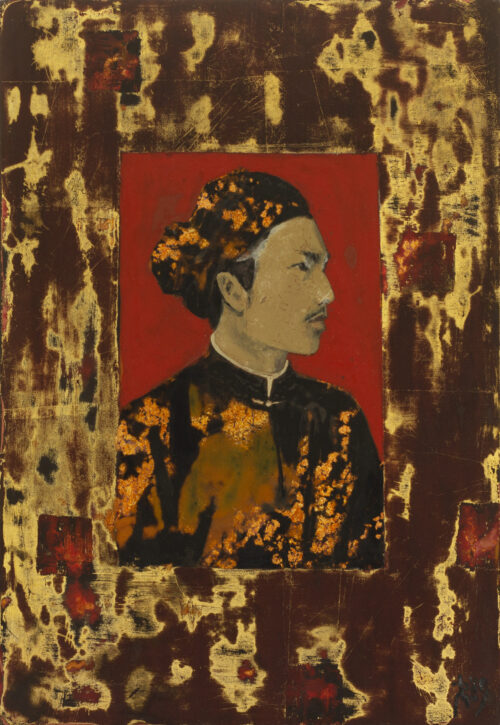
  • This two-panel lacquer painting is simply an exploration of how flowing water can strip away layers of material.
    One version remains unpolished, resplendent in gold.
    The other version is strongly polished, as if it were the ruins of history.

    • Size - 11 x 9 " (30 x 23 cm)
    • Material - Lacquer on wood panel
    • Year of creation - 2025
    • Published price -

  • This two-panel lacquer painting is simply an exploration of how flowing water can strip away layers of material.
    One version remains unpolished, resplendent in gold.
    The other version is strongly polished, as if it were the ruins of history.

    • Size - 11 x 9 " (30 x 23 cm)
    • Material - Lacquer on wood panel
    • Year of creation - 2025
    • Published price -

  • This two-panel lacquer painting is simply an exploration of how flowing water can strip away layers of material.
    One version remains unpolished, resplendent in gold.
    The other version is strongly polished, as if it were the ruins of history.

    • Size - 15 x 11 " (40 x 30 cm)
    • Material - Lacquer on wood panel
    • Year of creation - 2025
    • Published price -

  • Breaking King Duy Tân and Empress Nam Phương into tiny pixels symbolizes historical fragmentation. Most stories about them are incomplete, lacking accurate information. Their images in collective memory, books, legends, and films are never whole, like scattered pixels. Society continually reconstructs these images.

    • Size - 40 x 30 " (101 x 76 cm)
    • Material - colored pencil on zo’ paper & canvas
    • Year of creation - 2026
    • Published price -

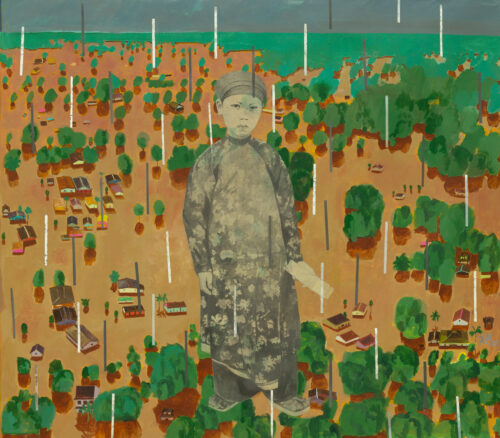
  • King Thành Thái, or a boy, standing in the floodthat submerges the ancient capital.

    • Size - 53 x 60 " (135 x 152 cm)
    • Material - Acrylic, graphite, dó paper, and silver leaf on canvas
    • Year of creation - 2025
    • Published price -

Title

Go to Top