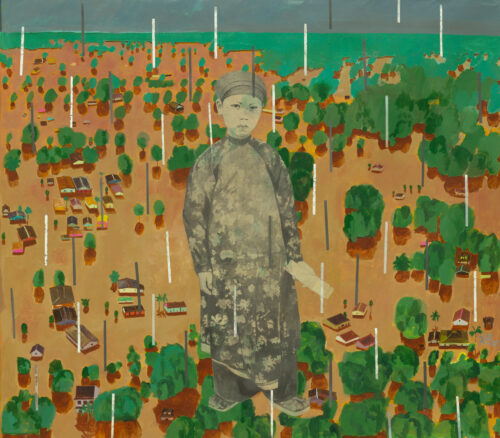
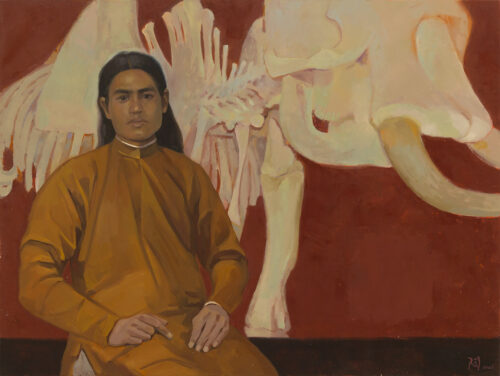
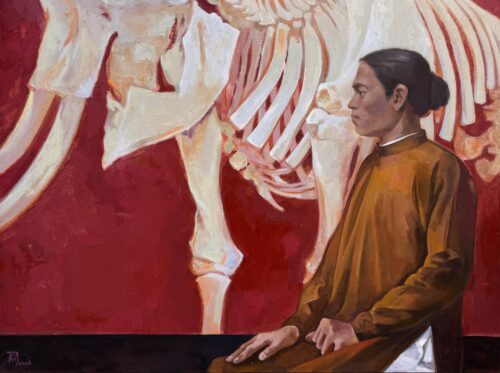
- Size - 130x80 (cm)
- Material - Oil on canvas
- Year of creation - 2022
-
The Red River has been a familiar presence to me since childhood.
From the moment I first began to form memories, I was already living near the river.
One of the very first sorrows I ever felt was when I accompanied my mother to the riverbank to see my father off — he was leaving for Laos for work.
We only saw him off at the ferry dock. After crossing to the other side, he would catch a long-distance coach over the Trường Sơn Mountains into Laos.
To my three-year-old mind, the Red River felt like a river of parting — and the far shore, a strange foreign land that had taken my father away for months.
One of my greatest childhood joys, too, was waiting at that ferry dock to welcome him home.
He would bring back all sorts of delicious treats — once even a child-sized bicycle with bright pink plastic spokes, bold and striking.
No one else in the village had a bike like that. It was my pride and joy throughout my early years.That’s why, when I try to paint imagined landscapes — places I’ve seen many times in dreams, like some sacred temple in my mind — I often paint the river, or a ferry landing.
There’s something hopeful in those images, but also something tinged with longing.
When I received the prompt for the Fairy–Dragon exhibition, I immediately thought of recreating the Red River’s landscape in the form of a votive painting.My two most recent oil paintings also depict a ferry landing — or the Red River shimmering faintly in the background.
-
Draw a younger sister with a solemn appearance, yet a rich and poetic inner world.
-
King Thành Thái, or a boy, standing in the floodthat submerges the ancient capital.
-
In 1863, after the Huế court signed the Treaty of Nhâm Tuất (1862), ceding to France three eastern provinces of Southern Vietnam (Gia Định, Định Tường, Biên Hòa) and Côn Lôn Island, Emperor Tự Đức still hoped to redeem them. The court therefore sent Phan Thanh Giản as chief envoy, accompanied by Phạm Phú Thứ, Ngụy Khắc Đản, and others, to France and Spain.
It is a sorrowful story; one no one likes to revisit. Reading Vietnamese history from that period feels overwhelmingly bleak. And yet, I found myself drawn to the portrait of a young man within the delegation.
A young man named Diệu. Twenty years old. Almost entirely unknown, leaving nothing in the historical record but his name and a single photograph. He was merely an attendant who accompanied the diplomatic mission to France.
I was captivated by his eyes. There is something clear and eager in them, the glimmer of youth sparking against the heavy gloom of the time. In his small, quiet presence, I see the reflection of the entire nation: ordinary people with dreams and passions of their own, swept into the tide of immense upheaval.
In events that seem to belong only to emperors and officials, what roles and memories remain for the nameless? They are both witnesses and those who bear the long echo of consequence.
—
The elephant skeleton carries its own meaning as well. The elephant, once a symbol of strength, authority, and the martial spirit of the imperial army, linked to many victories throughout the Lý, Trần, and Nguyễn dynasties, appears here only as the remains of a power that has faded. It evokes the late nineteenth century, when the country faced the loss of Southern Vietnam and the court stood powerless before foreign pressure.
-
Reflections blur into green depths, as if memory itself is submerged in moss and murmur.